Tuesday, October 23, 2012

Peekskill Officials to Search for New Management at Paramount Building

Peekskill Mayor Mary Foster said the locks have been changed to the building for the Paramount Center for the Arts and the city's Corporation Council is working on RFP for new management at the space.

 
While the City is moving immediately to get the theater operational again, officials are still waiting for a response from the existing board of directors of the Paramount Center for the Arts as to their plan to satisfy their existing financial obligations.
On Oct. 5, the City sent a written request to the board of directors to submit a written reorganization plan by Oct. 19. As a registered not-for-profit agency in New York State, the board of directors of the Paramount Center for the Arts is required to provide a final financial audit to the state.
The City of Peekskill is not responsible for any financial obligations incurred by the current operator, the Paramount Center for the Arts, and all inquiries related to its obligations should be directed to their board and its president.

----------------------------------
Have experience running an 82-year-old performing arts center?

Peekskill city officials said they are searching for new management to run the Paramount Center for the Arts after the theater’s board of directors announced the facility was going on a hiatus earlier this month.

“Our corporation council has been counsel has been dealing with the hired attorney’s of the Paramount board and the staff is working on developing a RFP that will go out for proposal in a very wide circle to see what proposal we’ll get back,” Peekskill Mayor Mary Foster said during Monday’s common council meeting.

Paramount officials made the announcement following a September fundraising campaign in which the goals was to raise $300,000. Vincent Vesce, the board president, said the money was needed to make up for a decrease in grants, sponsorships and other contributions.

According to the Paramount’s last filing with the state Charities Bureau on Aug. 31, 2011, the theater recorded a little more than $1,758,202 in expenses and $1,379,380 in expenses.

The Paramount has a deal in place to lease the building from the City of Peekskill for a dollar a year through 2033.

“There is a legal process to go through when the Paramount just announced on Oct. 3 that they were ceasing operations to getting this point—and getting control of the building,” Foster said.

Foster said locks to the building have been changed and the corporation council is working the Paramount’s attorney’s to determine what assets still exist in the building, what assets belong to the city and what assets belong to the Paramount. This information is necessary to determine what goes inside the RFP that’s sent out, according to Foster.

“Their [the Paramount’s] financial obligations are their financial obligations and they are working with their attorney’s on how they will deal with their obligations that they have to ticket holders, artists who have been cancelled, businesses, etc.,” Foster said.
 

Monday, September 10, 2012

Business Planning for Nonprofits

From NYCON's national partner, the National Council of Nonprofits:
True or False: “Business planning is for businesses, and strategic planning is for nonprofits."
Be honest. When you first heard the phrase "business plans for nonprofits," did you think, "We don't do that"? Many people think that businesses do business planning, and nonprofits do strategic planning. Strategic planning remains a core element of capacity building. State Associations of nonprofits report that strategic planning is perennially one of the most popular educational programs they offer. Funders often want to see a strategic plan along with a grant proposal. But increasingly, we’re hearing executive directors say to one another, “Do you have a business plan?” Are business plans for nonprofits becoming the new hot thing? And are they replacing strategic plans – simply by adding dollar signs?

Xerox adAdvertisement

Business planning is not the same as strategic planning. Ideally business planning will inform and improve a strategic planning process that keeps evolving. Business planning provides a sound financial context for the planning process and forces us to look at our nonprofit in the context of a competitive environment. It is hard work because it grounds big picture ideas in reality. Understandably given the option we might prefer to paint a canvas with a broad vision and fill in the colors, rather than first determine what it costs to buy the paint and canvas, and how to price our painting. (It’s much more fun to paint the picture and let somebody else figure out whether it will sell and for how much!) The problem for enthusiastic and inspired artists (as with board and staff members) is that the canvas gets bigger and bigger – but when the masterpiece is finished, there might not be a market for it.  
 
For us amateur artists, two recent books approach nonprofit business planning from a strategic planning perspective and explain it in a very accessible way, even for those not familiar with business terminology. The Nonprofit Business Plan: The Leader’s Guide to Creating a Successful Business Model , a new book by David La Piana and his distinguished colleagues at La Piana Consulting, may just change your attitude towards using the words “business” and “nonprofit” in the same sentence. Also take a look at Nonprofit Sustainability: Making Strategic Decisions for Financial Viability, by the terrific trio Jeanne Bell, Jan Masaoka, and Steve Zimmerman. We think both books are masterful in helping to explain why nonprofits need to pause and take a look at, well…let’s just say it, their “business model.”
 
Your nonprofit is in the business of something, whether it’s recycling computers, helping veterans rejoin the workforce, or preserving open space from development. And in order to pay for talented employees, that new website you dream of, and the internet connection that makes it work, your nonprofit needs cash. The problem is, assuming your nonprofit is like many others, it’s tempting to continually add new projects or improve existing programs to meet changing needs in the community. Just before a nonprofit launches that new program or makes the necessary adjustments, that’s the time to stop and ask, “How much is this really going to cost? And how will it be paid for?” The question should even be asked for services that clients pay for -- or that are paid by third-parties: “Are all the costs of the program paid for?” What we’re hearing is that many nonprofits have not calculated the full cost of running their operations. Consequently, the revenue received, whether through donations or fees for services (or a combination) might not cover 100% of what it costs to deliver those programs. Private philanthropy is concerned about this funding gap and the strain it puts on charitable nonprofits. The Donors Forum has convened a community of practice on the subject of overhead, bringing together funders and nonprofits to recommend how nonprofits can more easily identify and articulate the true cost of their work, and how grantmakers can become educated about the failure to pay full costs, as well as help nonprofits understand how to calculate the true cost of delivering services.
 
In today’s challenging economy, the severe consequences of failing to engage in business planning is laid bare when cash stops flowing. The cash flow crunch is a concern for a huge number of charitable nonprofits. The Nonprofit Finance Fund’s 2012 survey found that only 43% of nonprofits surveyed had more than 3 months of cash reserves – and many had less than one month. Nonprofits that continue to focus exclusively on what they do, instead of also what it costs to do it, will find themselves at risk of closing their doors for good. Here is just one example of the need for nonprofits and board members to focus strategically on business models: a 30 year old charitable nonprofit, dependent on donations to pay the rent and stay afloat, is hit hard by the recession when donations dry up. If the nonprofit closes its doors the community’s poor and disabled will be without access to medical equipment, such as wheelchairs, walkers, and oxygen tanks. For 30 years the nonprofit has collected donated equipment, refurbished it, and trained its new owners how to use it. For free. Now at the brink of being forced to shut down, the group’s executive director, reflecting on what happened, explained his mind-shift towards being more business oriented: “We’re not about money, but we have to be right now.”
 
A solid business plan will take into consideration not only the “vision” and the strategy for how your nonprofit will address needs in the community, but also how everything your nonprofit does fits within a competitive landscape, and how it will fund its activities in a cost-effective way. Done well, business planning is very comprehensive – and requires time. An outside consultant may be helpful to move the process along. The CEO, key program staff, and a few board members are usually tapped for the business planning team so that multiple perspectives inform the analysis of all aspects of the nonprofit’s operations: from mission delivery (programs, services, advocacy) to physical and human resources infrastructure, and marketing, to communications and fundraising activities. A business plan might also include funding projections, and address risk mitigation as well as how outcomes will be evaluated (and the associated costs).
 
The advantage of having a business plan in place – especially when an attractive new idea presents itself - is that some ventures, partnerships, or projects may strategically fit the mission and perfectly support the vision – but may not be successful financially. With the discipline of a business plan as the “enforcer,” it makes it easier to prioritize the activities that make the most financial sense, and to make hard decisions, such as stopping a program that offers little ROI. As champions for our nonprofits’ missions it is no longer enough to know deep in our bones that “the mission is good.” Instead we need to help boards and staff ask hard questions about money, so that the ability of each charitable nonprofit to deliver its mission into the future is protected. We encourage your nonprofit to take a look at the resources highlighted in this newsletter and on the Council of Nonprofits’ website, and we hope that when your nonprofit engages in this process, business planning will feel much more like painting a masterpiece than counting pennies.
Coming soon - a new look for this newsletter and the National Council of Nonprofits
 
Interested in learning more about business planning for nonprofits? Join us for a free webinar on October 18th with Heather Gowdy and Lester Olmstead-Rose, authors of The Nonprofit Business Plan: The Leader’s Guide to Creating a Successful Business Model. This webinar is an exclusive benefit for members of our network of State Associations. Contact your State Association for the registration link. Not a member? Find your State Association and join today!
 
This webinar is offered free of charge thanks to generous support from eCratchit


Resources on strategic and business planning (National Council of Nonprofits) 
 
The Nonprofit Business Plan: The Leader’s Guide to Creating a Successful Business Model , by David La Piana, Heather Gowdy, Lester Olmstead-Rose, and Brent Copen
 
Nonprofit Sustainability: Making Strategic Decisions for Financial Viability, by Jeanne Bell, Jan Masaoka, and Steve Zimmerman


Tools for business planning, creating a theory of change, a case for support, and building a revenue plan (for purchase from Social Velocity)
 
Congratulations to Valerie Lies, President & CEO, Donors Forum, and Ann Silverberg Williamson, President & CEO, Louisiana Association of Nonprofit Organizations, as well as Tim Delaney, President & CEO of the National Council of Nonprofits, for being named to the 2012 NonProfit Times Power & Influence Top 50 list.
 
The National Council of Nonprofits provides information about the failure of government to pay the full costs of services both on our Government-Nonprofit Contracting website and in Nonprofit Advocacy Matters, our bi-weekly newsletter on public policy and advocacy matters affecting charitable nonprofits. An upcoming edition of Nonprofit Advocacy Matters will include an update on federal reforms affecting indirect cost reimbursements. Subscribe today so you won’t miss the latest on this important issue.
Copyright 2012 National Council of Nonprofits. All rights reserved
1200 New York Avenue, NW | Suite 700 | Washington, DC 20005 | www.councilofnonprofits.org

Wednesday, August 15, 2012

Nominate an Outstanding CPA; Join the NYCON Board


2012 Michael H. Urbach, CPA, Community Builders Award Now Accepting Nominations
Submission Accepted through August 24th, 2012
Sponsored by the New York Council of Nonprofits (NYCON) and the New York State Society of Certified Public Accountants (NYSSCPA)
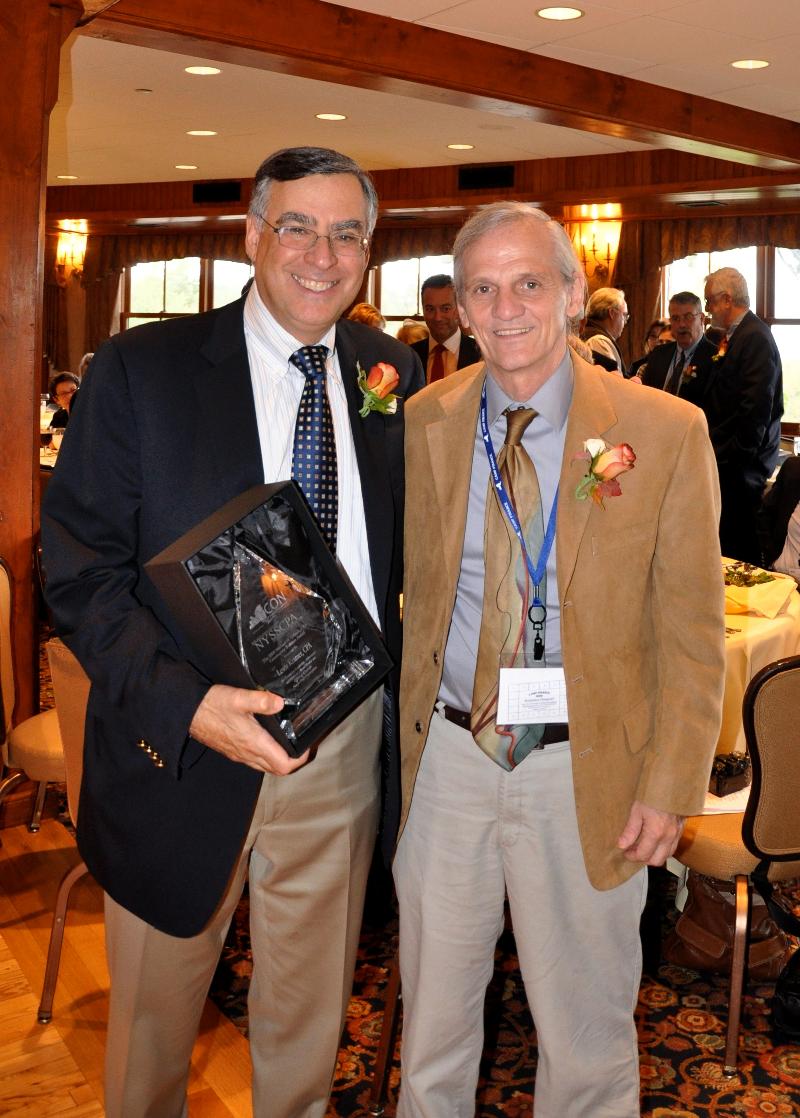
Lewis Kramer, Urbach Award Recipient and Doug Sauer, CEO, NYCON

The New York Council of Nonprofits, Inc. (NYCON) and the New York State Society of Certified Public Accountants (NYSSCPA) are pleased to announce this call for nominations for the Ninth Annual Michael H. Urbach, CPA Community Builders Award.

The award is named in honor of the late Michael H. Urbach, CPA, former partner of Urbach, Kahn and Werlin, former NYS Commissioner of Tax and Finance and Chair of the State Employees federated Appeal, and board leader of a number of charities. This award is in recognition of the important role, talents and leadership that a Certified Public Accountant (CPA) in New York State can provide as a board member for community-based charities.

Award Criteria & Submission
Candidates must:
  1. Be a CPA in good standing and a member of NYSSCPA.
  2. Have served as an Officer on at least 3 different charitable 501(c)(3) community-based nonprofits with service as President/Chair at least once.
  3. Have demonstrated exemplary board leadership resulting in significant and positive organizational impact including, but not limited to, financial turn-around, growth, and/or organizational re-structuring.
  4. Preference will be given to nominees whose board leadership accomplishments have been with community-based charities.
Deadline - August 24th, 2012
Nominations addressing the candidate's qualifications must be received by August 24th. Nominators are strongly encouraged to address the qualifications related to the four (4) criteria mentioned above and to include at least three (3) letters of support from the charities who have benefited from the candidate's volunteer leadership.

Send two (2) packets of nomination materials to:
Urbach Community Builders Award Committee
New York Council of Nonprofits
272 Broadway
Albany NY 12204
or email the packet to Melissa Currado, Executive Assistant to the CEO at mcurrado@nycon.org.


NYCON Now Accepting Applications for Board Membership
A great opportunity to volunteer your time and lend your expertise to help nonprofits of all types improve the quality of life in New York State.
The New York Council of Nonprofits' Board Development Committee is now accepting applications for nominees for its Board of Directors.

Terms are for three years, starting January 1, 2013, with a three consecutive term limit. Successful nominees will be presented for election to our Membership at NYCON's Annual Meeting on October 4th in New Paltz.
Applicants must be individuals of high integrity, demonstrate commitment to our state's nonprofit sector, and be willing to invest the time, effort, expertise and influence necessary on a regional and statewide basis to further NYCON's mission.

All applications will be considered by the Board Development Committee however priority consideration will be given to individuals who meet more than one of the following characteristics:
  • Resides in Hudson Valley, Metro New York or Central New York regions
  • Has public policy knowledge & expertise, particularly with respect to state government
  • Has marketing & Media Relations expertise
  • Is affiliated with Organized Philanthropy
  • Has Banking & Corporate Business expertise & affiliations
  • Is a racial or ethnic minority
Applications are due by August 27th, 2012. If you are interested we encourage you to review the NYCON "Board Brief" document and complete the application below:
Candidates are recommended to the Board by the Committee and the Board in turn recommends a slate to the NYCON Membership which convenes for our Annual Meeting at Mohonk Mountain House on October 4th during Camp Finance.

Board members elected by the members begin service in January 2012.

Questions?Please contact us.
All About the Board Members...


Thank You to Our Supporters!

NYCON and NYSSCPA would like to recognize The Community Foundation for the Greater Capital Region for their grant contribution towards the Michael H. Urbach, CPA Community Builders Award.


For More Information
visit NYCON at
or contact
Melissa Currado at (800) 515-5012 or
mcurrado@nycon.org


Co-sponsored by
The New York State Society of Certified Public Accountants
 
nysscpa

Wednesday, August 8, 2012

Is Your Nonprofit Ready for Health Care Reform?

NYCON's insurance subsidiary Council Services Plus (CS Plus) offers info, resources and direct insurance assistance to nonprofits across NYS. CS Plus only works with nonprofits, and has brought over $1 million in savings to nonprofit clients. Visit www.councilservicesplus.com for more info or e-mail.
Health Care Reform: Are You Prepared?
The United States Supreme Court largely upheld President Obama's health care law, the Affordable Care Act in a mixed decision. The court's ruling, seen as one of the most significant in decade, is a crucial milestone for the law, allowing almost all of its far-reaching changes to roll forward. The decision did significantly restrict one major portion of the law: the expansion of Medicaid, the government health-insurance program for low-income and sick people. The ruling gives states more flexibility not to expand their Medicaid programs, without paying the same financial penalties that the law called for.
The legislation for the Patient Protection and Affordable Care Act (PPACA) will impose significant new responsibilities on employers, some of which are already effective. While further guidance is expected on the application of these requirements, the following provides a summary and timeline of key provisions of the PPACA. As employers look ahead to the implementation of the PPACA, CS Plus will be providing additional updates to provide clients with compliance strategies in connection with various components of the new law.
Summary of the Affordable Care Act
The Affordable Care Act (umbrella term for the Patient Protection and Affordable Care Act and the Health Care and Education Reconciliation Act of 2010) was passed by Congress in March 2010 to overhaul the health care system, expand affordable coverage, change insurance rules and create an online marketplace (exchange) in each state for the individual and small group markets.

Most U.S. citizens and legal residents will be required to have health insurance in 2014. Those without coverage would pay a tax penalty based on household income to be phased-in starting in 2014. Federal subsidies will be available to assist those who cannot afford to purchase coverage.

Large employers (50 or more full-time employees) will be required to "pay or play" starting in 2014.

Qualifying small employers (no more than 25 employees) are eligible for a tax credit for offering coverage beginning in 2010. The tax credit increases in 2014 if employers buy from the exchange, and then phases out in 2016.

How Health Reform will Impact Businesses
The Patient Protection and Affordable Care Act (PPACA) impacts businesses in several ways - from the types of benefits offered under insurance plans, to the ways employers conduct their businesses. Some provisions are already in effect and more will be implemented over the next several years.

General Impacts on Employer-Provided Coverage
There are several mandates from the Patient Protection and Affordable Care Act (PPACA) already in effect. View the Timeline below for more information on timing of provisions.

Some of the key mandates are below.
Grandfathering - "Grandfathering" allowed some plans to be exempt from some Health Care Reform provisions.
Lifetime Limits and Annual Limits - Law prohibits imposing annual limits on Essential Health Benefits and any lifetime dollar limits.
Medical Loss Ratio (MLR) Reporting - A Medical Loss Ratio or MLR is the percentage of premium dollars insurers spend to provide covered medical services and improve the quality of health care for their members.
No Pre-Existing Conditions Exclusions - As of September 2010 there are no pre-existing exclusions for children under age 19. Beginning in 2014, this provision applies to everyone, including adults.
Patient-centered Outcomes Research Fee - The Patient-Centered Outcomes Research Tax, also known as the Comparative Effectiveness Research Fee, is a fee paid to the government to fund Patient-Centered Outcomes Research Institute (PCORI) research.
Preventive Services - The Patient Protection and Affordable Care Act of 2010 (PPACA) requires health plans to cover designated preventive services without any member cost sharing.
Summary of Benefits Coverage - The Departments of Health and Human Services, Labor and Treasury recently issued final regulations requiring health plans to provide a SBC and Uniform Glossary that clearly explain benefits and coverage within a standardized template with uniform language.
W-2 reporting - PPACA contains a requirement for employers to report the cost of health coverage under an employer sponsored group health plan on an employees W-2 form. The cost includes both the cost paid by the employer and contributions from the employee.
Women's Preventive Services - The Patient Protection and Affordable Care Act (PPACA) requires health plans to cover designated women's preventive services without cost sharing for the member. Cost-sharing includes deductibles, copayments and coinsurance. Some of the benefits and services outlined in the women's preventive guidelines are already included within the existing PPACA preventive services requirements.
Establishment of Health Insurance Exchanges
On April 12, 2012 Governor Andrew M. Cuomo issued an Executive Order to establish a statewide Health Exchange. State-established health insurance exchanges must begin to operate on January 1, 2014. The Exchanges are virtual marketplaces that allow individuals and eligible employers to purchase health insurance. Initially in 2014, only employers with up to100 employees can purchase insurance for their employees through the Exchange. Prior to 2016, states can limit the size to businesses with up to 50 employees. Beginning in 2017, states can allow employers with more than 100 employees to purchase health insurance for their employees through the Exchange.

How Does Health Care Reform Affect Small Businesses?
In addition to the key provisions outlined, it's important to know that small businesses already have an opportunity to qualify for:
Small business tax credits - In an effort to help small employers offer affordable coverage to their employees, the Patient Protection and Affordable Care Act provides for tax credits for qualified small employers. These credits began in 2010. The credits increase in 2014, but are only available for coverage purchased on an Exchange. The small group tax credit sunsets in 2016.

Timeline
It will take several years for changes to be enacted and regulations written. However it's important to begin to understand what will be happening in the near future versus long term changes.
HC Reform Timeline
To view a larger image of the timeline, CLICK HERE.


If you have any questions regarding this update, please contact Anthony DeCicco, Account Executive, Group Benefits at adecicco@councilservicesplus.com;
or by phone at (877) 501-4277, ext 123.

Friday, June 1, 2012

Nonprofits Talk Strategy in the Hudson Valley

The Wall Street Journal, in an article by Melanie Grayce West, gave an overview of NYCON's recent work at Omega Institute with a number of nonprofits:

This week, 25 nonprofits from the region are taking a brief retreat in the Hudson Valley to not only take in the fresh air, but to talk strategy.

The organizations are gathering for the seventh annual "Service Week" and the "Women Serving Women Summit" at the Omega Institute for Holistic Studies in Rhinebeck, N.Y. The Dyson Foundation, based in Millbrook, N.Y., is sponsoring a portion of the retreat.
 
The programs are designed to help grassroots nonprofits take a little time to reflect on planning so they can better serve their clients. Generally, there's very little funding available to nonprofits to cover strategic planning or better collaboration, and cash-strapped organizations with few staff members can rarely afford the working time to reflect and plan. This week's retreats include time to meet to develop a strategic plan and at an on-site "nonprofit wellness clinic" sponsored by the New York Council of Nonprofits.

Participating organizations include many that serve women and children, like Hollaback, a Brooklyn-based anti-harassment organization, and the Lower Eastside Girls Club. Other organizations work in healthcare, domestic violence, mental health and with children.

The Dyson Foundation was founded in 1957 by Margaret and Charles Dyson and initially focused its funding on scholarships. Mr. Dyson made his fortune in leveraged buyouts and founded the Dyson-Kissner-Moran Corporation, a privately owned international holding company.
The Dyson family has ties to the Hudson Valley and the foundation concentrates its funding to the six counties in the mid-Hudson Valley region and on nonprofits that provide basic needs and a safety net of services—organizations that address hunger, access to healthcare, housing and afterschool programs, to name a few. At the same time, the foundation was a big supporter of the Walkway over the Hudson, a pedestrian park that spans the Hudson River.

Annually, the foundation grants around $18 million and provided $25,000 to cover the costs of the retreats at the Omega Institute.

An additional area of funding for the Dyson Foundation is to help support the health of nonprofits, be it with strategic restructuring, mergers or consultant trainings to increase capacity, says program officer Cecilia R. Stancell.
"An organization needs to be effective in order to deliver quality services to a community and to clients," says Ms. Stancell. While program grants provide funding for staffing and direct expenses, those grants do not address an organization's possible underlying problems, she says. "If an organization is not managed as well as it could be or doesn't have the capacity in terms of staffing and financing to deliver programs effectively, the clients will not be served as well as they could be."

Write to Melanie Grayce West at melanie.west@wsj.com
A version of this article appeared May 31, 2012, on page A23 in the U.S. edition of The Wall Street Journal, with the headline: Nonprofits Talk Strategy in the Hudson Valley.

Monday, April 16, 2012

New York Attorney General Eric Schneiderman to Discuss Nonprofit Reform and Revitalization at Annual Summit

United Way of Westchester and Putnam's 10th annual Not-For-Profit Leadership Summit to attract a sold-out crowd of more than 600
. .New York State Attorney General Eric Schneiderman will be the keynote speaker for the Not-For-Profit Leadership Summit X presented by the United Way of Westchester and Putnam

The United Way of Westchester and Putnam in partnership with the Westchester Community Foundation present the Not-For-Profit Leadership Summit X on Monday, May 7, 2012. This year’s event, held from 8:00 a.m. to 4:00 p.m. at the Doubletree Hotel Tarrytown, features keynote speaker New York State Attorney General Eric Schneiderman, who will discuss his plan to “reform and revitalize” the state’s nonprofit sector.

“New York is the proud home of the world’s most dynamic and vibrant nonprofit sector, but for too long, our state’s regulatory framework has placed unnecessary burdens on these essential organizations. It’s time to unlock the full potential of our nonprofit community, and improve the lives of the countless New Yorkers they serve every day,” said Attorney General Schneiderman. “In these difficult economic times, it is more important than ever to make New York a hospitable environment so nonprofits can continue to carry out their vital work. At the same time, we must maintain the public’s trust by ensuring that nonprofits are governed effectively, and with meaningful oversight.”

In 2010, nonprofits employed 1.2 million people, or nearly one of every five people in New York’s private sector (Crain’s New York February 2012). However, as the demand for nonprofit services increases, government funding has weakened. In February, Schneiderman unveiled legislation that would eliminate outdated and costly burdens on nonprofits, strengthen oversight and accountability, and reaffirm his office’s commitment to policing fraud and abuse. Acknowledging that organizations throughout New York face historic financial and strategic challenges, his plan also includes several new partnerships with the business and academic communities to enhance nonprofit governance.

The Leadership Summit kicks off at 8:30 a.m. with the breakfast keynote speaker, Bartley “BJ” Costello, Esq., partner with Hinman Straub P.C., who is a well-known legal expert and has done considerable advocacy work on both sides of the isle in Albany.

“We are delighted to welcome Eric Schneiderman and B.J. Costello.” said Naomi Adler, president and chief executive officer of the United Way of Westchester and Putnam. “It is a perfect time to dive deeper into the subject of reforming regulations of the nonprofit sector with the Attorney General and to learn from BJ Costello how nonprofits can work together more effectively to lead legislators in the direction of smart policies.”

After breakfast, attendees will be able to choose from sixteen breakout sessions on topics such as web technologies, strategic planning, profitable fundraising techniques, work/life balance, skills-based volunteerism, social media in the workplace, executive compensation, IT outsourcing, and board strategies, among others. Schneiderman will address the group during lunch at 11:45 a.m.

“Nonprofit agencies face a multitude of challenges, but the biggest hurdle remains: providing Westchester residents the services they need, every day, while federal, state and local governments cut essential funding,” said Catherine Marsh, executive director of the Westchester Community Foundation. “Everyone in the audience will be eager to hear the Attorney General’s presentation and provide constructive feedback.”

The Leadership Summit is underwritten in part by the TD Charitable Foundation. Gold sponsorship is provided by ConEdison and the afternoon reception is sponsored by NonProfit Guard. Other sponsors include BDO, Council Services Plus, Pragmatix, Association of Development Officers, Fordham University – Westchester Campus, Long Island University – Hudson, Mutual of America, Nonprofit Coordinating Committee of New York, Helene & Grant Wilson Center for Social Entrepreneurship at Pace University, POW'R Against Tobacco, US Alliance Federal Credit Union and Westchester Arc. There is a $30 non-refundable event fee for a nonprofit’s initial reservation. Each additional participant from the same organization is $20. Walk-in registration is $35, space permitting. Sponsorships and vendor tables are also available. The Doubletree Hotel Tarrytown is located at 455 S. Broadway, Tarrytown, NY 10591. For more information or to register, call 914.997.6700 ext. 704 or visit http://www.uwwp.org/summit.shtml.

About the Westchester Community Foundation
THE WESTCHESTER COMMUNITY FOUNDATION (WCF) is a nonprofit community endowment for the benefit of Westchester County. Its mission is to develop and manage philanthropic resources, and to distribute them in a way that is responsive to donor interests and community needs. The Foundation actively promotes charitable giving on behalf of the area’s nonprofit organizations. WCF is a division of The New York Community Trust, one of the largest community foundations in the country with assets of approximately $1.8 billion.

About the United Way of Westchester and Putnam
Celebrating its 50th anniversary in 2012, United Way of Westchester and Putnam operates with the fundamental belief that all people deserve a quality education, enough income to support a family, and opportunities for a healthy lifestyle. The not-for-profit organization works with agency partners, government, businesses and community leaders to solve problems that are too complex for any one entity alone. All contributions go toward improving the education, income, and health of the children, youth and families throughout Westchester and Putnam. United Way’s Hudson Valley Region 2-1-1, covering Westchester and Putnam as well as Dutchess, Orange, Rockland, Sullivan and Ulster counties, answers up to 500 calls and 1,000 online inquiries per day ranging from tax, heating, and mortgage questions to childcare, basic needs, natural disaster and crisis calls. United Way of Westchester and Putnam is at 336 Central Park Ave., White Plains, NY 10606. They can be reached at 914-997-6700 or by visiting http://www.uwwp.org. Follow United Way on Facebook (http://www.facebook.com/UnitedWayWP) and Twitter (@UnitedWayWP) for the latest news and updates.